Gold is the oldest material in human decoration. Before writing, before cities, before most of what we consider civilization, people were working gold — pressing it into thin sheets, drawing it into wire, setting it with stones found in rivers. They were making the same things we make now.
That continuity is not accidental. Gold survives. It does not corrode, does not tarnish, does not react to the chemistry of skin or air or time. A piece of gold jewelry pulled from a two-thousand-year-old burial site looks, with cleaning, like something made last week. That is remarkable. That is why gold has held meaning for as long as humans have needed something to hold meaning.
Gold does not change. That is not a metaphor. It is chemistry. And it is why we use nothing else.
Why 18k specifically
Pure gold — 24 karat — is too soft for jewelry that is meant to be worn. It bends, scratches, loses its shape. Gold in jewelry is always alloyed with other metals to increase durability. The question is how much.
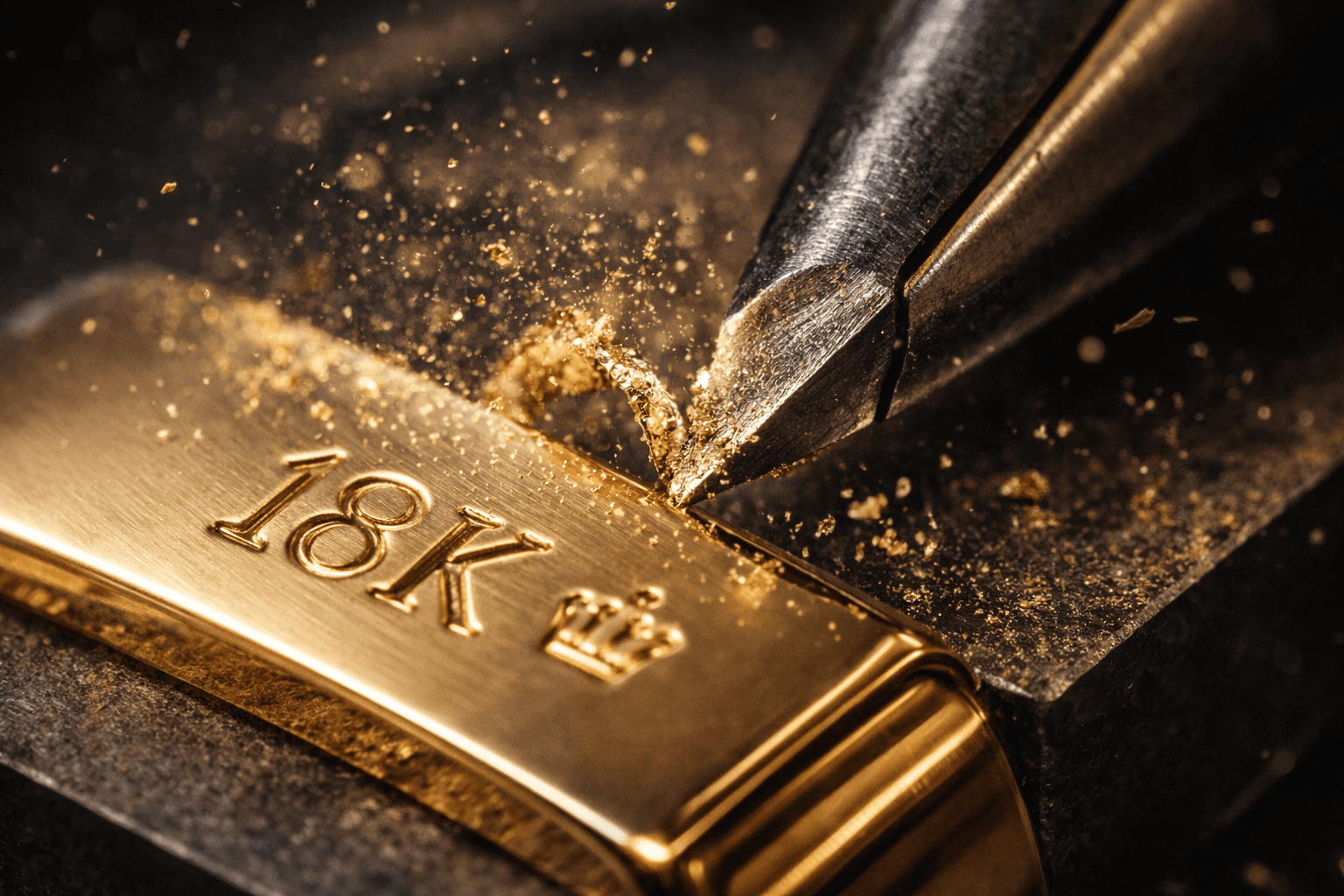
18k gold is 75% pure gold, alloyed with 25% other metals — typically silver, copper, and small amounts of palladium or zinc. This ratio produces a metal that is hard enough to hold a prong setting, soft enough to be worked by hand, and rich enough in gold content to wear like gold: warm, weighty, honest.
14k gold — more common in North America for reasons of cost — contains only 58.5% gold. It is harder, more scratch-resistant, but noticeably paler and thinner in tone. The gold begins to recede behind the alloy. We find this unsatisfying. If gold is the point, it should be present.
The colour question
Yellow gold is gold in its most honest form. The warm champagne tone is the natural colour of the alloy at 18k — the thing itself, without treatment or plating. It works with every skin tone because it is a warm neutral, not a cool one.
White gold is yellow gold alloyed with white metals and then plated with rhodium to achieve a bright silver tone. The plating wears over time, revealing the yellow-gold base beneath — which requires replating. Rose gold achieves its pink tone through a higher copper content. Both are legitimate choices, but both involve compromise: white gold requires maintenance, rose gold is subject to fashion cycles. Yellow gold simply is.
Yellow gold simply is. It has been the same colour since before anyone decided what was fashionable.
On wearing it
18k gold develops a patina over years of wear. Microscopic surface scratches accumulate and scatter light differently than polished metal — producing what jewelers call a satin or lived-in finish. Some people polish their pieces regularly to restore the original brightness. Others let the patina develop. We are in the latter camp. A piece of gold that has been worn for ten years looks like a piece of gold that has been worn for ten years. We find that beautiful.
This is a material that ages honestly. It does not pretend. It does not hide. It simply holds — everything it has witnessed, and the light in whatever room you happen to be standing in.